


After a weekend of fast-moving developments, mounting international fallout, and intensifying constitutional questions, the global response to the United States’ capture of Venezuelan President Nicolás Maduro is now coming into sharper focus.
Initial details of the operation emerged late Friday and continued to unfold through the weekend. By Sunday and early Monday, however, governments, lawmakers, and advocacy organizations began issuing formal, on-the-record statements. As markets reopened and diplomatic channels reengaged at the start of the week, the episode evolved from a dramatic military action into a broader debate over U.S. power, international law, and Congress’ constitutional role in authorizing foreign interventions.
What Happened
At approximately 2 a.m. local time on January 3, U.S. military aircraft and special operations forces launched a surprise offensive in Caracas aimed at seizing Maduro and his wife, Cilia Flores, according to U.S. and Venezuelan officials.
The operation targeted multiple locations across the capital, including radar and air-defense installations and Maduro’s residence inside the Fort Tiuna military complex, one of the most heavily fortified sites in the country. Residents reported explosions, widespread power outages, and low-flying aircraft over large sections of Caracas as U.S. forces moved into the city.
Venezuelan authorities said the strikes resulted in casualties among military personnel and allied foreign nationals and acknowledged civilian deaths and injuries, though the exact toll remains unclear and independent verification has been limited. U.S. officials said the timing of the operation was selected to reduce the risk of civilian casualties, but did not provide a detailed accounting.
President Donald Trump later confirmed the operation, describing it as a successful mission to bring Maduro and Flores into U.S. custody. The White House said the action—referred to by the administration as Operation Absolute Resolve—was conducted to enforce existing U.S. criminal indictments against Maduro, including charges related to narcotics trafficking and narco-terrorism.
Trump posted an image showing Maduro in U.S. custody aboard a U.S. Navy vessel, confirming that the Venezuelan leader had been captured alive and removed from the country. Administration officials said Maduro was transferred out of Venezuela within hours of the operation’s conclusion.
Maduro and Flores were subsequently flown to New York City, where they are being held at the Metropolitan Detention Center. Federal prosecutors said Maduro is expected to make an initial appearance in Manhattan federal court as early as Monday to face charges stemming from a multi-count indictment alleging cocaine trafficking, conspiracy, and weapons-related offenses.
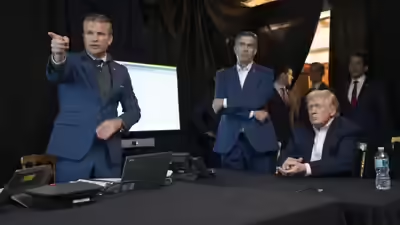
The entire operation lasted just over two hours, according to U.S. officials. Trump later said he followed the mission in real time from Florida and described it as decisive. The administration has characterized the action as a law-enforcement operation supported by military assets, a framing that has been disputed by legal scholars and international observers.
Congressional Leaders Raise Constitutional Concerns
Reaction in Washington was swift, particularly among Democratic lawmakers who questioned the absence of congressional authorization.
U.S. Senate Democratic Whip Dick Durbin said he opposed the use of military force without congressional approval, calling it a troubling expansion of executive authority.
Durbin said that while Maduro had repeatedly denied the will of the Venezuelan people, a Justice Department indictment could not substitute for Congress’ constitutional role when military force is used. Durbin also referenced his own 2018 visit to Venezuela and said he recently spoke with opposition leader María Corina Machado and President-elect Edmundo González, whom he said should be allowed to rebuild the nation without foreign military control.
U.S. Rep. Frank J. Mrvan acknowledged the harm international drug trafficking has caused communities in Northwest Indiana and described Maduro as a “bad actor,” but said Congress must be consulted before actions that could place American troops in harm’s way.
Mrvan also highlighted what critics have described as an inconsistency in the administration’s approach, noting that former Honduran President Juan Orlando Hernández—convicted in the United States on narcotics charges—was recently pardoned by Trump.
Domestic Political and Advocacy Reaction
Several Illinois leaders issued strong condemnations.
U.S. Rep. Robin Kelly called the operation shortsighted, warning it could destabilize the region and demanding a vote on the War Powers Resolution. U.S. Rep. Kweisi Mfume described the action as an illegal invasion and questioned the administration’s priorities amid rising domestic costs.
Chicago Mayor Brandon Johnson said the action violated international law and escalated the risk of war, while Second District congressional candidate Willie Preston called it a dangerous precedent driven by oil interests rather than public safety.

Civil rights organization Black Lives Matter Grassroots condemned the operation as unlawful and accused the administration of pursuing regime change under the guise of drug enforcement, citing Trump’s public comments about Venezuela’s oil reserves.

Global Reaction and Diplomatic Fallout
International response was sharply divided.
At the United Nations, Secretary-General António Guterres warned the action set a “dangerous precedent” and called for respect for international law. The U.N. Security Council is expected to convene to discuss the operation.
Russia, China, Cuba, Brazil and Mexico condemned the action as a violation of Venezuelan sovereignty. Cuba said its personnel were among those killed in the strikes, a claim that has not been independently verified.
European leaders responded more cautiously. Some expressed relief at Maduro’s removal but stopped short of endorsing the U.S. action, emphasizing stability and restraint. Israeli Prime Minister Benjamin Netanyahu, by contrast, praised Trump’s leadership and described the operation as decisive.
Monroe Doctrine Echoes and What Comes Next
Trump’s remarks about “running” Venezuela and asserting U.S. dominance in the Western Hemisphere revived debate over the Monroe Doctrine, a 19th-century policy long associated with U.S. influence in Latin America.
Maduro remains in U.S. custody awaiting court proceedings, while Venezuela’s vice president, Delcy Rodríguez, has declared herself interim leader and denounced the United States as an illegal invader.

Inside Venezuela, reactions remain mixed. Supporters of Maduro have protested his removal, while some opponents expressed uncertainty about what U.S. involvement means for the country’s future. In South Florida, members of the Venezuelan diaspora celebrated the capture, highlighting deep divisions among Venezuelans at home and abroad.
In Washington, pressure is mounting for hearings, classified briefings, and possible War Powers resolutions. How Congress responds may shape not only Venezuela’s future, but the balance of power between the presidency and Congress for years to come.