As Black wealth hemorrhages and the trades remain closed to Black workers, a South Side sewing school answers the call issued 144 years ago.
By Stephanie Gadlin
Inside a converted warehouse at Ada S. McKinley Community Services on Chicago’s South Side, a row of industrial sewing machines hums with purpose. Students in matching polo shirts lean into their work, stitching leather sleeves onto varsity jackets, embroidering logos onto hoodies, learning one of the trades that built Black Wall Street before America decided African American hands should hold degrees instead of hammers.
BEE Fashion School is a state-funded workforce development program co-created by State Sen. Mattie Hunter (D-Chicago) and Calvin “Taboo” Jarrett, a master tailor and iconic Chicago stepper. Since its launch in 2024, the program has graduated four cohorts of students who leave with a certificate of completion, training in business formation, a paycheck, and a state-of-the-art Singer sewing machine in hand.
“I want to give them a certificate of completion in one hand and a sewing machine in another,” Hunter told the Crusader. “Many of the kids and adults, when they finish these training programs, they don’t have any monies to buy the equipment that they need to start a business. So, we added a business component. An advisor comes in and teaches them how to start their own business, how to fill out the paperwork for the state, and then they are given the most important asset they need to open for business, a brand-new sewing machine.”
Jarrett, globally recognized as an originator of Steppin’, founded BEE as a manufacturing company in 1989. BEE stands for Building/Black Economic Empowerment. While he provides instruction and mentorship to the apprentices, his daughter, Shelly Cunningham, handles administrative, fundraising, and management functions as the school’s senior program manager.
“I handle the training, curriculum, and trade components, and my daughter handles the business side,” Jarrett said, moments after correcting a student’s stitch. “There is an art to steppin’, and there’s an art to sewing. Both involve tapping into music coming in the ear and coming into your heart. Once these kids get it, they’ve got it and gone. I have one (apprentice) who is now in Ghana building an apparel business.”

The sewing school, at 1112 E. 87th Street, operates with state grant funding through nonprofit Ada S. McKinley, with CEO Jamal Malone serving as fiscal agent.
Hunter, who represents the 3rd legislative district and has served in the Illinois Senate since 2003, secured funding through the Illinois Works Pre-Apprenticeship Program, part of more than $1.8 million in pre-apprenticeship investments she championed in 2024. A staunch advocate for access to capital and education, the legislator has built a career that addresses the needs of the most marginalized, disregarded and disinvested people in the state.
“This could not have happened without Sen. Hunter,” Jarrett said, through tears. “People talk about what our elected officials don’t do, but they miss what they (do) do. Because of her, we are sending young people out to create wealth for themselves. They learn a skill that cannot be replaced by (artificial intelligence), and they can use it anywhere in the world. We have got to get back to building from the ground up like our ancestors did way before and well after slavery. It’s the only way we can ensure they have a future.”
The U.S. apparel market generated $365.7 billion in retail sales in 2024. American consumers spend that money. American workers, and specifically Black workers, do not make the clothes.
In 1950, approximately 2.5 million Americans worked in the textile and apparel industries, according to Bureau of Labor Statistics historical data. New York City’s garment district alone employed 323,669 workers at its peak. Those factories did not begin with immigrant labor or Asian capital. They began, as the Garment District’s own historical records document, by manufacturing clothes for enslaved people on Southern plantations. The industry was seeded in Black bondage and grew wealthy on it.
Between 1990 and 2014, U.S. apparel manufacturing employment collapsed by more than 912,000 jobs, which is a decline of 84 percent, according to the U.S. Department of Commerce. Companies moved production to wherever labor could be controlled at the lowest cost. China now employs approximately 20 million apparel manufacturing workers. India employs 45 million. Vietnam employs 2.8 million. The United States employs approximately 82,000 people in its entire clothing sector, according to 2025 industry data.
Of the roughly 20,500 tailors, dressmakers, and sewers still working in America as of 2022, according to the Bureau of Labor Statistics, Black workers are nearly absent from occupational overrepresentation data. The remaining domestic cut-and-sew workforce is concentrated in California, New York, and Texas, dominated by Latino and Asian immigrant workers. Black workers are substantially overrepresented in nursing assistance, security, transit, and home health, not on cutting tables or sewing floors.
Black workers have been squeezed out of what remains. African Americans make up just 7.3 percent of fashion designers nationally, according to workforce data compiled by Zippia, and only 8.8 percent of seamstresses. Among tailors, the picture is slightly better at 17 percent, but that figure obscures a deeper absence: the pipeline that once trained Black craftspeople in cities like Chicago has been dismantled. Within the Council of Fashion Designers of America, only 3 percent of members are Black.
The sewing machine, once a tool of Black economic independence and wealth generation, now sits idle in communities where few, other than Jarrett, teaches the trade.
HISTORICAL CONTINUITY
More than a century ago, Booker T. Washington built Tuskegee Normal and Industrial Institute on the principle that economic self-sufficiency, not political agitation alone, would secure Black freedom. “No race can prosper till it learns that there is as much dignity in tilling a field as in writing a poem,” Washington wrote. His students made their own bricks, built their own buildings, grew their own food, and graduated with trades that made them indispensable to the Southern economy torn apart by the Civil War. Except now they had to be paid.
When Black medical students and nurses faced Jim Crow and no opportunity, Washington’s students built hospitals, nursing schools, and clinics to employ them. Tuskegee’s science and agricultural department designed tools and techniques to assist farmers and businessmen of both races. “The Educator,” as he was known to millions of freed men and women in the U.S., also founded the National Black Business League in 1900. Within a year of its inception, more than 3,000 new Black-owned businesses were launched.

Washington’s philosophy was not without critics. W.E.B. DuBois argued for the Rockefeller Foundation’s “Talented Tenth” of college-educated Black men who would uplift the race through intellectual and political achievement. The Harvard graduate labeled Washington as the “great compromiser,” and as an “accommodationist,” and as a writer spearheaded a massive anti-Washington campaign, often carried through Black newspapers. The debate fractured Black educational strategy for generations, and later, Du Bois renounced the campaign. But both men understood the same truth: without economic power, political rights could be legislated away.
DuBois revisited the Talented Tenth idea in his 1948 “Talented Tenth Memorial Address” to Sigma Pi Phi, in which he critiqued the educated elite’s failure to uplift the masses. He realized that training this group risked creating “a group of selfish, self-indulgent, well-to-do men, whose basic interest in solving the Negro problem was personal; personal freedom and unhampered enjoyment and use of the world, without any real care… as to what became of the mass of American Negroes.”
What neither Washington nor DuBois could have predicted was what came next. The Great Migration brought six million of Black Southerners to Northern cities, where they built thriving economic districts. Bronzeville in Chicago. Hayti in Durham. Harlem in New York. Greenwood in Tulsa, despite being locked out of labor unions and the workforce. These communities produced their own tailors, cobblers, printers, and seamstresses. Then came urban renewal, highway construction, and the deliberate destruction of Black commercial districts. The trades that had sustained Black economic independence were dismantled along with the neighborhoods.
CLOSED SCHOOLS & TRADE PROGRAMS
Chicago Public Schools followed the national trend. Vocational education was stripped from the curriculum. Home economics disappeared. Shop class became a memory. The message to Black students was clear: pursue the degree, not the trade. In 2013, Mayor Rahm Emanuel made history by closing 54, the most in a single action. Nearly all of them were located in predominantly Black neighborhoods, and all were named for historical African American icons.
“CPS also took the arts out of the schools,” Hunter said. “For many of the kids, that’s (the reason) why they went to school: because of the sports, the art programs, the music programs. They took all of that stuff out of our community, out of the schools. I had to find a way to restore some of this at the community level. Since the city wouldn’t do it, the IL General Assembly is doing it ourselves with state funds.”
Jarrett echoed the senator’s framing. He said he learned his craft the old way. As a student at Dunbar High School, he enrolled in a tailoring class and was required to take drafting. At 16, he answered a newspaper ad for sewing machine operators and walked into a factory at 1243 S. Wabash.
“I see them big old sewing machines,” Jarrett recalled. “The guy gave me a broom. He said, ‘You clean the place up, and you take the bundles to the ladies.’ And at lunch, them same ladies taught me how to sew. I was the only Black person in there. Within a year, I was the best sewer in that factory.”
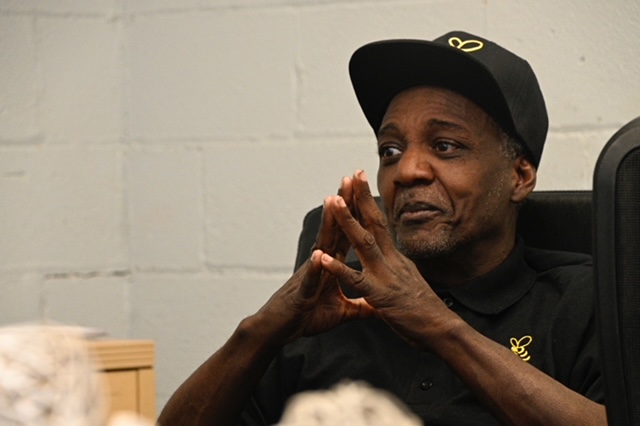
For decades, Jarrett made custom jackets for professional athletes, politicians, and Chicago steppers. He crafted custom pieces for the recent Democratic National Convention. He dressed aldermen and NBA players. But scaling the business required something he could not manufacture alone, and that was access and a cadre of emerging tailors, seamstresses, and fashion designers he could train in his signature methods and sewing techniques.
Hunter said had been searching for an African American tailor for years. “I couldn’t find any Black tailors, nobody that can sew,” she said. “I found older people, and they said, well, I’m retired. I’m tired. I’d go to certain cleaners, and I still couldn’t find any Black tailors or somebody sewing clothes.”
And then, a mutual friend of Jarrett and Hunter arranged a meeting at Pearl’s Place. The senator ordered catfish and greens. The master tailor barely ate. Within days, she visited his shop and saw the jackets hanging on the rack. “These are beautiful,” she told him. “Looks like or better than some stuff that you would buy in any of the (downtown) stores.”
She commissioned jackets for her staff. Then came Phillips High School. When the Wildcats won the state basketball championship, Hunter called Jarrett. He made leather-sleeved varsity jackets for the entire team, complete with their jersey numbers and names. The retail price would have easily been $500 each, but Jarrett charged nowhere near that price tag. At the ceremony, he also surprised the players with custom championship rings.
“When you treat these young people with dignity and respect, they start acting differently,” Hunter said. “Their self-esteem goes up.”

BEE students receive a stipend while they learn. The curriculum covers machine operation, pattern cutting, embroidery, and leather work. A separate instructor teaches entrepreneurship and business formation. Hunter, a certified substance abuse counselor, later added a trauma and grief support component after recognizing that some students carried burdens that affected their focus.
Young people get early lessons in retail. They often secure orders from individuals or groups and, as professionals, process and fulfill them. On the day this writer visited, some apprentices were making satin, embroidered pillows, and others were learning stitching techniques. Graduates from early cohorts, such as Abdul, Emmanuel, and Corianna, have been hired back as teaching assistants. They wear gold polo shirts to distinguish themselves from current students, who wear black.
“When they graduate and get their own logo, and they put their logo on the other side,” Jarrett said, tapping over his heart. “So everybody sees the connection, even when you’re in public. I talk to them about branding. On Fridays, I might give them a lesson in steppin’—the correct way to do it, not no eight count—so I can also teach them the history of this art form and make sure our culture is preserved by the next generation. “
One graduate from the first cohort, the grandson of legendary Chicago artist, civil rights champion, and musician Oscar Brown Jr., described what the program meant to him.
“My purpose right now is just, I’m being guided by God every day,” he told the Crusader. “When I come in here, I’m happy to come here every day. This is what I’m building–my future.”
Booker T. Washington once urged Black Americans to see beyond the jobs available to them and envision ownership. “Let the young colored man feel that he can be not only a waiter in the hotels, but proprietor,” Washington wrote. “Not only a porter, but the conductor, and he will go forward.”
Hunter sees that vision alive in her students. “That is so true,” she said. “We have so much talent in our community, but there’s an access issue. You give us an opportunity (and) you give us access. Next thing, you know, we’re going to wind up owning the whole darn thing.”

Jarrett is already planning the next phase. He is in preliminary discussions with Ada S. McKinley to launch BEE Manufacturing as a nightshift operation inside the facility where he can offer employment to former students until they open their own companies. He has also set his sights on being the first African American tailor and apparel business inside Midway International Airport.
“Every time I go through the airport, and I see all of these jerseys, I say, man, I gotta call the senator and the mayor,” Jarrett said. “If we get a store at the airport, you’re talking about a billion-dollar company where young, Black men and women are going to make custom jerseys for travelers—with their name or that of their favorite player.”
Despite the school’s success and calls to replicate it around the country, both leaders say the program’s future is not guaranteed. Hunter acknowledged that proposed federal budget cuts threaten workforce development funding at every level. She returns to Springfield this week as the legislature enters the final push before the May 31 budget deadline.
“We’re facing some very critical times right now with the budget,” Hunter said. “The cuts are real, and they’re very serious. I’m going to have to do all I can to the best of my ability to preserve these programs, because they mean so much to our community.”
Jarrett offered one final observation. When artificial intelligence threatens to replace workers across industries, one machine remains irreplaceable.
“The sewing machine is the only machine they can’t replace with a robot because it has to have human hands,” Jarrett said, before pausing to reflect further. “Senator Hunter gave me the okay to dream again. I’ve got all this talent. But talent don’t work by itself. I’ve never been able to save a penny as long as I’ve been doing this. When Senator Hunter came in my life, this is first time I’ve been able to save some money and turn around and help others make a good life for themselves too. She just changed my life.”
Hunter smiled. “When people dream, dreams do come true.”

Stephanie Gadlin is an award-winning, independent investigative journalist whose work blends historical analysis, data reporting, and cultural commentary. Her work is published in the Crusader and other publications across the country. She specializes in uncovering the intersections of Black culture, public health, environmental justice, systemic racism, public policy and economic inequality in the U.S. and across the African Diaspora. For confidential tips, please contact: [email protected]
- Stephanie Gadlin

- Stephanie Gadlin

- Stephanie Gadlin

- Stephanie Gadlin

- Stephanie Gadlin