

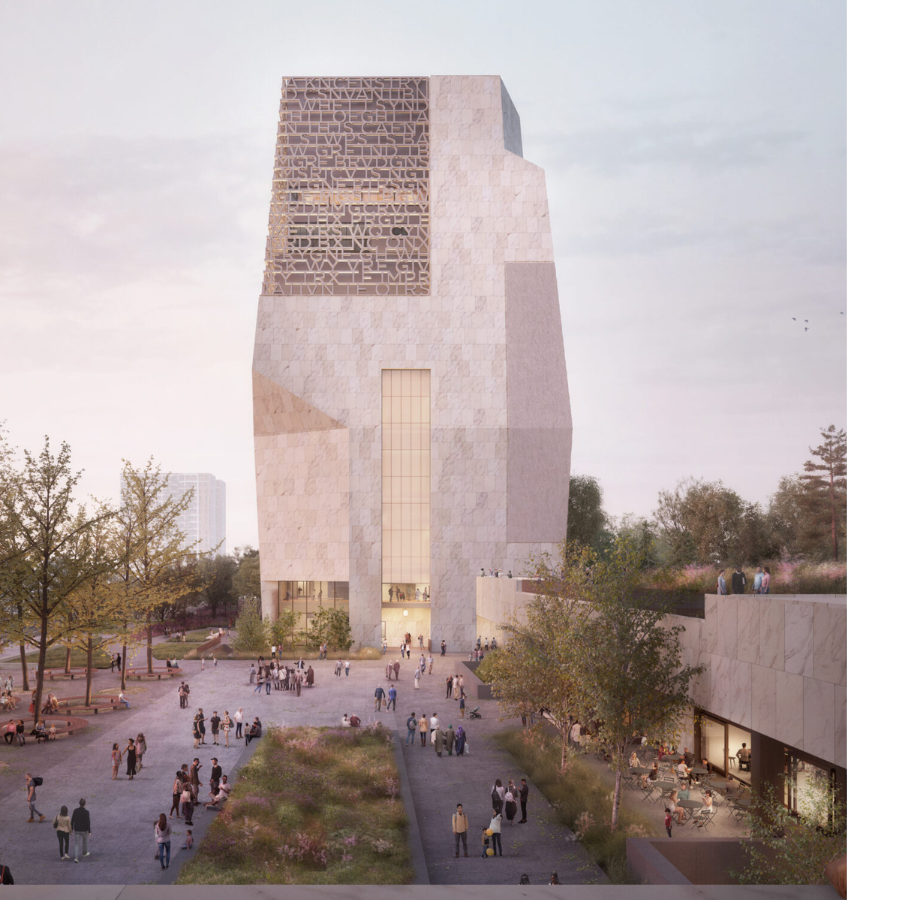
After a decade of planning, construction, and ongoing concerns about gentrification in Woodlawn and South Shore, the Obama Presidential Center and Library in Jackson Park is slated to open in June, former President Barack Obama announced on Monday, December 1, 2025, during an event in Arkansas.
While no exact date has been provided, Obama—speaking during a visit to the Crystal Bridges Museum of American Art—said the opening month will allow visitors to enjoy the museum without having to “bring their coats.”
Located on nearly 20 acres in Jackson Park at 60th Street and Stony Island Avenue, the $800 million campus will be the largest and most expensive presidential library in U.S. history. Its 225‑foot museum tower anchors a campus that will feature an auditorium, a Chicago Public Library branch, an athletic center, gardens, and new parkland. The Center will not include the presidential records from Obama’s two terms; those are being digitized and processed by the National Archives.
Since September, the Obama Foundation has provided free community tours for residents, elected officials, and neighborhood leaders.
The Obamas lived in Hyde Park before Barack Obama made history in 2008 as the nation’s first Black president.
The Center was initially proposed for Washington Park before the Obama Foundation announced in 2015 that Jackson Park had been selected, near the Museum of Science and Industry. Foundation leaders hope the Center will bring significant tourism and economic investment to the surrounding neighborhoods.
Beginning in 2017, Chicago Department of Transportation (CDOT) officials worked to address concerns that the Center would increase traffic in Woodlawn and South Shore. In 2023, CDOT completed a major project that added an additional lane to South Lake Shore Drive between 57th Street and Marquette Drive. Additional lanes were added along Hayes Drive, and portions of Cornell Drive were rebuilt. City officials previously approved the Center’s plan to close part of Marquette Drive inside Jackson Park, though it remains unclear whether that closure will occur.
While the Center has been highly anticipated, housing advocates remain concerned about the impact of rising rents and displacement.
The Center sits in an area surrounded by apartment buildings and single‑family homes in South Shore and Woodlawn. South Shore remains one of Chicago’s poorest neighborhoods, yet developers see the area’s proximity to the lakefront as prime real estate.
Over the last year, the Chicago Crusader has reported on several South Side tenants who were displaced after their buildings went into foreclosure. Other buildings have undergone extensive rehabs, reopening with higher rents that many longtime residents cannot afford.
During the early planning phases, housing organizers pushed the Obama Foundation to support a community benefits agreement to safeguard residents as development accelerated. Obama initially rejected the proposal, but in 2017, the City Council voted 48‑0 to approve agreements related to the Center between the City of Chicago and the Obama Foundation.
In September, the Council approved the Jackson Park Housing Pilot ordinance, establishing a pilot area stretching from 60th Street to 71st Street and from King Drive to DuSable Lake Shore Drive—covering nearly all of Woodlawn and portions of South Shore and Greater Grand Crossing.
Speaking Monday, Obama emphasized that the Center’s mission is to support the next generation of civic leaders across a range of fields.
“We want to create a campus, a place where the public gathers for a range of things that puts them face to face with each other and get them to meet and be in dialogue and conversation and exposed to new ideas with each other,” Obama said.
“Our main focus is young people from 25 to 35 who are already doing remarkable things,” he continued. “They’re doing great work already, but they don’t have a lot of a support system.”
Obama said the Center will also create a virtual classroom for civic education. “My bet is that all the issues, problems that we have right now will be solved if old folks get out of the way,” he added.
“We’ll bring those good old‑fashioned American values to new sets of problems that any of us, even my age, you know, we’re not going to experience.”