

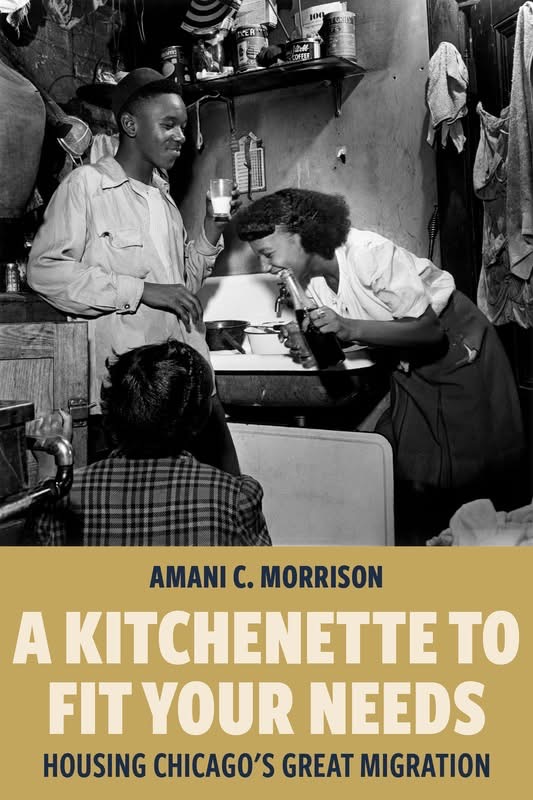
You would think that Blacks leaving the South during the First Wave of the Great Migration would have enough to worry about when they sought housing in Chicago’s Black Belt. However, according to a new deep dive into the formation of “kitchenettes” in the area, “new” Blacks had to be concerned about the so-called “Old Settlers,” who often disparaged their own community members.
In “A Kitchenette To Fit Your Needs: Housing Chicago’s First Migration,” Amani C. Morrison writes about the creator of kitchenettes Grace Garnett, who had her mother living with her in Chicago—also known as the “Black Metropolis.” While Garnett looked out for her family members, she looked at new migrants who doubled up to secure housing for their own family units with disdain.
The book reveals that while Garnett found it financially prudent to have her mother live with her at her three-story home at 3627 S. Vernon Ave., she didn’t deem that familial arrangement good for others. She was a businesswoman and decided to take the top floor of her home, make it into two apartments, each consisting of a room and a kitchen, and rent it out to new residents from the South.
However, Garnett kept her bourgeoise leanings. In a 1941 Works Progress Administration interview, “She vilified the ‘new class’ of migrants— who wanted to offer relatives a place to land in their transition to the city—despite the practicality of these desires and actions.

“Although her comments reflect the increasingly subdivided housing stock’s growing inadequacy to accommodate the Black families needing to secure housing in the segregated city, Garnett treated this fact as a character and behavioral flaw of kitchenette tenants. Yet many people living in kitchenettes in the Black Belt (or Bronzeville) were making do within the limited residential landscape the city had to offer them.”
Other sources spoke about the feelings that other established Blacks had about the newcomers.
St. Clair Drake and Horace Cayton wrote in “Black Metropolis: A Study of Negro Life in a Northern City” (1945) that “middle- and upper-class Blacks worked to actively distinguish themselves from the lower classes through behavioral and social proscription, as well as self-aggrandizement. They emphasized their differentness.”
The upper crust Bronzeville inhabitants were considered respectable, and they would rather not cross paths with the destitute who were considered vice-leaning. However, if the newcomers had adhered to leaflets distributed by the Chicago Urban League during that time, as written by Isabel Wilkerson in “The Warmth of Other Suns,” they would have known to stay on the straight and narrow, as to avoid friction with established residents. I liken this to migrants signing a morality pact.
The kitchenettes, which formally popped up around 1914, were a blessing and a curse in many ways. Black folks during that time (the book notes 1910 to 1940) needed places to live, and it didn’t matter how many family members were cooped up in a room or two.

Kitchenettes were small apartments produced by the subdivision of a larger apartment flat: A multi-room apartment was subdivided into multiple one- and two-bedroom apartments, separated by beaverboard walls, each housing a family of four or five.
Kitchenettes signified migrant influx, economic decline and the ruin of fine houses because of the subdivisions, and tenants paid higher rents for squalid living conditions.
In the late 1930s, The Chicago Housing Authority found that 44.9 percent of kitchenette residents paid more than 30 percent of their income in rent, much higher than what was suggested.
There was a communal bathroom, often in disrepair, with toilets running over because of the constant flushing, floors that may have sustained flooding and were covered with newspapers. These wet conditions invited disease and vermin.
Morrison writes: “Once heralded for their efficiency, Chicago’s kitchenettes became synonymous with subdivided, dilapidated housing and became notorious symbols of housing injustice on the South and West sides.”
The story of James Hickman highlights how kitchenettes symbolized housing ills, as well as the physical and moral hazards facing Black Chicagoans. Hickman lost almost everything after a fire at his home in January 1947. He took his landlord’s life, and the case became national news. He had migrated to Chicago in 1945 with his family; worked hard at a steel mill.

He had a wife and at least seven kids. The family lived in a West Side attic apartment; he was swindled out of a deposit for a lower unit and threatened with a fire when he wouldn’t move out and make way for further conversions.
Hickman lost family members, and he later travelled to Bronzeville and murdered his 23-year-old Black landlord, David Coleman. Hickman received a plea deal—supposedly the loss of his kids was considered enough punishment.
On the upside, kitchenettes fostered community among families—whether relatives or not. Folks shared meals, coordinated bathroom schedules, looked after each other’s children, etc.
One chapter spoke of the lack of intimacy. Morrison writes: “There were no ‘properly’ private spaces in many kitchenettes. In fact, the lack of privacy inherent in kitchenette buildings meant that sexual taboos were lived out in the open, and people’s actions and lives were singled out for deviance and correction.
“Kitchenette buildings were sometimes bases for sex work, and many families did not have the option to choose their own social proximity to such activities.” St. Clair Drake and Horace Cayton report interviewees decrying sex workers who were variably described as “hustling women,” “prostitutes,” and, the most demeaning, “whores.”

“I think you’ll find them in every kitchenette apartment. Nearly everybody in here is doing first one thing and then another.” Another woman remarked with vehemence, “Honey, this place is full of whores…. If I could get me another place, I wouldn’t be here.”
In the late 1950s, the Black Woodlawn neighborhood was called, alternately, the “Kitchenette District” and “Sin Corner,” due to the high number of kitchenettes and to sex workers openly soliciting in that area.
In the chapter “Family Business: The ‘Indestructible Contradictions’ of the Hansberry Family’s Kitchenettes,” Lorraine Hansberry’s landmark play “A Raisin in the Sun” had as its integral setting a three-room kitchenette. Her father, Carl, ran a successful real estate company, beginning in the 1930s, but even with that success, his buildings were in some cases falling apart, and he reportedly was sued on a couple of occasions.
Morrison writes: “The home space of ‘A Raisin in the Sun’s’ Younger family is probably the most iconic kitchenette apartment in American arts and letters. The play has become, for many, instructive of the nature of Chicago kitchenette living in the immediate postwar era. It is ironic, then, that the kitchenette of the play, as central as it is to the entirety of the play’s action, does not align with the materialities of Chicago’s historical kitchenettes in a number of ways”—in other words, the Younger’s apartment didn’t appear to be in dire conditions.
The final chapter, “Out of This Frying Pan into That Fire: From Kitchenette Living to Public Housing Fight,” explains the movement into Chicago’s public housing.
The end of World War II brought about significant changes in Chicago’s residential landscape. These changes impacted the racial geography of the city, but many changes were not implemented to benefit Chicago’s Black residents.
The existing housing on the South and West sides was increasingly demolished, requiring residents to find new housing for themselves or wait on long waitlists for available public housing units. The 1947 Illinois Blight Redevelopment Act initiated a more systematic demolition of residential areas under the banner of “slum clearance.” And thus began the wave for better housing conditions for thousands of Black residents.

As a post script. My family lived in a kitchenette in the mid-50s, after coming from Mississippi. My mom recalls she and my father and three children living in one room on 48th and Federal. The adjacent room was shared by an aunt and uncle, whose family also totaled five; we all shared the bathroom and kitchen. Both men worked in the stockyards.
There were scheduled cooking times. My mom says another uncle owned the one-story house with a basement apartment—one of his many properties. In 1959, my family bought a home in Englewood. My aunt’s family eventually moved to the Ickes and later purchased in Auburn Gresham.
“A Kitchenette To Fit Your Needs: Housing Chicago’s First Migration” covers much and is available on Amazon and nyupress.org; search for Amani Morrison. It’s a great account, particularly for Chicagoans represented by the Migrations, as well as a book that is perfect for academia.
